HAVING
In MySQL, the HAVING clause is used in conjunction with the GROUP BY clause to filter the results of a query based on aggregate functions.
The HAVING clause is applied after the GROUP BY clause and allows you to specify conditions for groups of rows. It is primarily used with aggregate functions like SUM, COUNT, AVG, etc.
Syntax
SELECT column_name
FROM table_name
WHERE condition
GROUP BY column_name
HAVING condition
Example
Suppose we have a Students table as shown below:
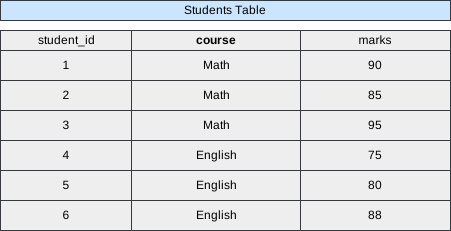 Image scaled to 70%
Now, let’s say you want to find courses where the number of students who scored above 79 is greater than 1. You can use the HAVING clause for this:
SELECT course, COUNT(student_id) as total_students
FROM Students
WHERE score > 79
GROUP BY course
HAVING total_students > 1;
Database Exercise
Database Schema:
-- Database schema would be rendered hereExercise Script:
-- Exercise script would be rendered hereAvailable actions: Execute
In this example:
- We select the
coursecolumn and count the number of students who scored above 79 usingCOUNT(student_id)for each course. - We use
WHERE score > 79to filter out individual rows where the score is not greater than 79 before grouping. - We use
GROUP BY courseto group the data by the course. - The
HAVINGclause filters out groups where the number of students is not greater than 1.
The result of this query would be:
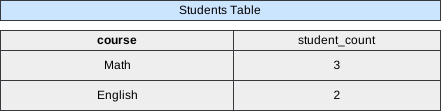 Image scaled to 70%
This result includes both “Math” and “English” courses because they have more than one student who scored above 79.