Problem
Table: Products
+-------------+------+
| Column Name | Type |
+-------------+------+
| product_id  | int  |
| price       | int  |
+-------------+------+
product_id contains unique values.
Each row in this table shows the ID of a product and the price of one unit.
Table: Purchases
+-------------+------+
| Column Name | Type |
+-------------+------+
| invoice_id  | int  |
| product_id  | int  |
| quantity    | int  |
+-------------+------+
(invoice_id, product_id) is the primary key (combination of columns with unique values) for this table.
Each row in this table shows the quantity ordered from one product in an invoice.
Problem Definition
Write a solution to show the details of the invoice with the highest price. If two or more invoices have the same price, return the details of the one with the smallest invoice_id.
Return the result table in any order.
Example
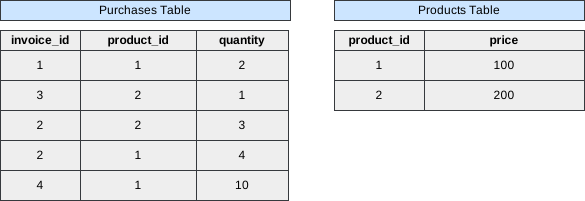 Image scaled to 80%
Output
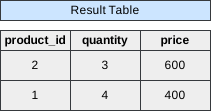 Image scaled to 35%
Try It Yourself
Database Exercise
Database Schema:
-- Database schema would be rendered hereExercise Script:
-- Exercise script would be rendered hereAvailable actions: Execute
Solution
To identify the invoice with the highest total price, and in the event of a tie, select the one with the smallest invoice_id, we can follow a systematic approach using SQL’s aggregation and window functions. The solution involves calculating the total price for each invoice, determining the highest total price, handling ties by selecting the smallest invoice_id, and finally retrieving the detailed information of the selected invoice.
Approach Overview
-
Join
PurchaseswithProductsto Calculate Subtotal per Product:- Combine the
PurchasesandProductstables to access the price of each product. - Calculate the subtotal for each product in an invoice by multiplying
pricebyquantity.
- Combine the
-
Aggregate Subtotals to Determine Total Price per Invoice:
- Sum the subtotals for each
invoice_idto obtain the total price of each invoice.
- Sum the subtotals for each
-
Identify the Invoice with the Highest Total Price:
- Determine the maximum total price across all invoices.
- In cases where multiple invoices share this maximum total price, select the one with the smallest
invoice_id.
-
Retrieve Detailed Information of the Selected Invoice:
- Fetch the
product_id,quantity, and subtotal (price) for each product within the selected invoice.
- Fetch the
SQL Query
WITH details_by_invoices AS
(
    SELECT
        pu.invoice_id,
        pu.product_id,
        pu.quantity,
        pu.quantity * pr.price AS price
    FROM
        Purchases AS pu
    INNER JOIN
        Products AS pr
    ON
        pu.product_id = pr.product_id
),
invoice_with_max_total AS
(
    SELECT
        invoice_id
    FROM
        details_by_invoices
    GROUP BY
        invoice_id
    ORDER BY
        SUM(price) DESC,
        invoice_id ASC
    LIMIT 1
)
SELECT
    product_id,
    quantity,
    price
FROM
    details_by_invoices
WHERE
    invoice_id IN
    (
        SELECT invoice_id
        FROM invoice_with_max_total
    );
Step-by-Step Approach
Step 1: Join Purchases with Products and Calculate Subtotal per Product (details_by_invoices)
Combine the Purchases and Products tables to calculate the subtotal for each product within an invoice.
SQL Snippet:
WITH details_by_invoices AS
(
    SELECT
        pu.invoice_id,
        pu.product_id,
        pu.quantity,
        pu.quantity * pr.price AS price
    FROM
        Purchases AS pu
    INNER JOIN
        Products AS pr
    ON
        pu.product_id = pr.product_id
)
SELECT * FROM details_by_invoices;
Explanation:
-
INNER JOIN:- Combines each purchase (
pu) with its corresponding product (pr) based onproduct_id.
- Combines each purchase (
-
Calculate Subtotal (
price):- Multiplies
quantitybypriceto compute the subtotal for each product in an invoice.
- Multiplies
-
Common Table Expression (CTE)
details_by_invoices:- Stores the resulting data for further processing.
Intermediate Output After Step 1 (details_by_invoices):
+------------+------------+----------+-------+
| invoice_id | product_id | quantity | price |
+------------+------------+----------+-------+
| 1          | 1          | 2        | 200   |
| 3          | 2          | 1        | 200   |
| 2          | 2          | 3        | 600   |
| 2          | 1          | 4        | 400   |
| 4          | 1          | 10       | 1000  |
+------------+------------+----------+-------+
Step 2: Aggregate Subtotals to Determine Total Price per Invoice
Calculate the total price for each invoice by summing the subtotals of all products within that invoice.
SQL Snippet:
WITH details_by_invoices AS
(
    SELECT
        pu.invoice_id,
        pu.product_id,
        pu.quantity,
        pu.quantity * pr.price AS price
    FROM
        Purchases AS pu
    INNER JOIN
        Products AS pr
    ON
        pu.product_id = pr.product_id
),
invoice_with_max_total AS
(
    SELECT
        invoice_id
    FROM
        details_by_invoices
    GROUP BY
        invoice_id
)
Explanation:
-
GROUP BY invoice_id:- Aggregates all products within the same invoice.
-
SUM(price) AS total_price:- Calculates the total price for each invoice by summing the subtotals of its products.
-
Common Table Expression (CTE)
invoice_with_max_total:- Identifies the invoice with the highest total price, handling ties by selecting the smallest
invoice_id.
- Identifies the invoice with the highest total price, handling ties by selecting the smallest
Intermediate Output After Step 2:
+------------+-------------+
| invoice_id | total_price |
+------------+-------------+
| 1          | 200         |
| 2          | 1000        |
| 3          | 200         |
| 4          | 1000        |
+------------+-------------+
Step 3: Identify the Invoice with the Highest Total Price (invoice_with_max_total)
Determine which invoice has the highest total_price. In the case of a tie, select the invoice with the smallest invoice_id.
SQL Snippet:
WITH details_by_invoices AS
(
    SELECT
        pu.invoice_id,
        pu.product_id,
        pu.quantity,
        pu.quantity * pr.price AS price
    FROM
        Purchases AS pu
    INNER JOIN
        Products AS pr
    ON
        pu.product_id = pr.product_id
),
invoice_with_max_total AS
(
    SELECT
        invoice_id
    FROM
        details_by_invoices
    GROUP BY
        invoice_id
    ORDER BY
        SUM(price) DESC,
        invoice_id ASC
    LIMIT 1
)
SELECT * FROM invoice_with_max_total;
Explanation:
-
ORDER BY SUM(price) DESC, invoice_id ASC:- Sorts the invoices first by descending
total_priceto prioritize higher totals. - In case of a tie in
total_price, sorts by ascendinginvoice_idto select the smallest ID.
- Sorts the invoices first by descending
-
LIMIT 1:- Ensures that only the top invoice is selected based on the sorting criteria.
Intermediate Output After Step 3 (invoice_with_max_total):
+------------+
| invoice_id |
+------------+
| 2          |
+------------+
Step 4: Retrieve Detailed Information of the Selected Invoice
Fetch the product_id, quantity, and subtotal (price) for each product within the selected invoice.
SQL Snippet:
WITH details_by_invoices AS
(
    SELECT
        pu.invoice_id,
        pu.product_id,
        pu.quantity,
        pu.quantity * pr.price AS price
    FROM
        Purchases AS pu
    INNER JOIN
        Products AS pr
    ON
        pu.product_id = pr.product_id
),
invoice_with_max_total AS
(
    SELECT
        invoice_id
    FROM
        details_by_invoices
    GROUP BY
        invoice_id
    ORDER BY
        SUM(price) DESC,
        invoice_id ASC
    LIMIT 1
)
SELECT
    product_id,
    quantity,
    price
FROM
    details_by_invoices
WHERE
    invoice_id IN
    (
        SELECT invoice_id
        FROM invoice_with_max_total
    )
ORDER BY
    product_id;
Explanation:
-
WHERE invoice_id IN (SELECT invoice_id FROM invoice_with_max_total):- Filters the
details_by_invoicesto include only the selected invoice.
- Filters the
-
ORDER BY product_id:- Sorts the output by
product_idfor organized presentation.
- Sorts the output by
Final Output:
+------------+----------+-------+
| product_id | quantity | price |
+------------+----------+-------+
| 1          | 4        | 400   |
| 2          | 3        | 600   |
+------------+----------+-------+
Explanation of Output:
-
Product 1:
- Quantity: 4
- Price per unit: $100
- Subtotal: 4 × $100 = $400
-
Product 2:
- Quantity: 3
- Price per unit: $200
- Subtotal: 3 × $200 = $600
-
Total for Invoice 2: $400 + $600 = $1000
Note:
- Invoice 4 also has a
total_priceof $1000, but Invoice 2 is selected because it has the smallerinvoice_id.