In the relational model, relations, tuples, and attributes are core concepts that define how data is organized within a database. Understanding these components is essential for effective data management, as they form the structure of relational databases.
Relations
A relation in the relational model is essentially a table, where each table represents a specific type of entity or concept.
- Structure: A relation consists of rows and columns, where each column is an attribute, and each row represents a tuple.
- Naming: Relations are named based on the entity they represent, such as Student, Employee, or Order.
- Unique Set of Tuples: Each row (or tuple) in a relation is unique, ensuring no duplicate data entries.
Example: In a Student relation (table), each row might represent a single student, and columns could include attributes like Roll Number, Name, and CGPA.
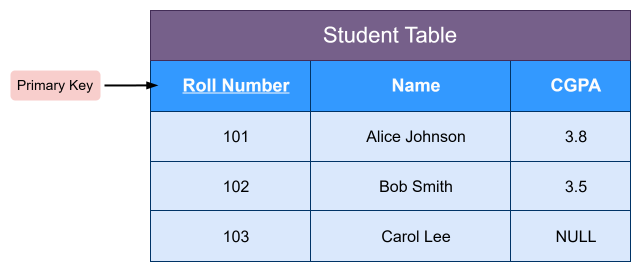
In this Student table:
- Roll Number is a unique identifier for each student.
- Name represents the student’s full name.
- CGPA shows the student’s cumulative grade point average, with a null value if the CGPA is not available.
Tuples
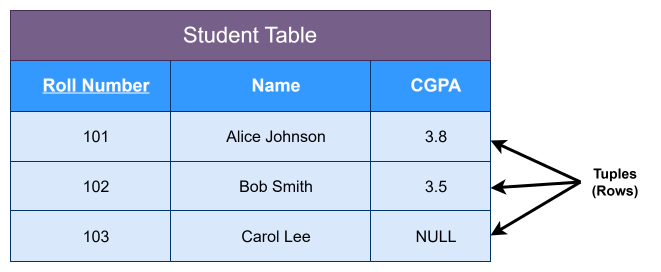
A tuple is a single row in a relation, representing a unique instance of an entity.
- Individual Record: Each tuple is a specific record in the relation.
- Attribute Values: A tuple contains values for all attributes in the relation.
Example: In the Student relation, a tuple might represent one student with a specific Roll Number, Name, and CGPA.
Attributes
An attribute is a column in a relation that represents a property or characteristic of the entity.
- Data Field: Attributes are the columns in a table.
- Data Type: Each attribute has a specific data type, such as integer, text, or date, which defines the type of values it can hold.
Example: In the Student relation, Roll Number, Name, and CGPA are attributes, each holding specific details about the student.
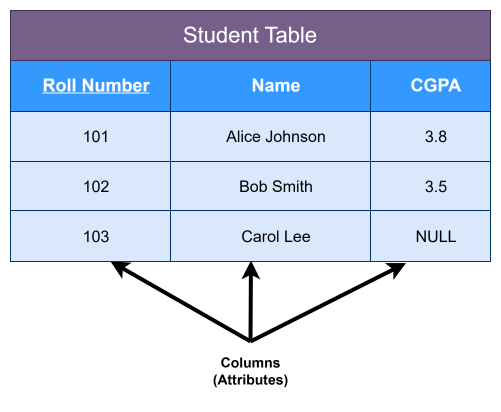 Image scaled to 80%
Important Terminologies
In addition to relations, tuples, and attributes, the relational model includes other important terms:
-
Domain: The domain of an attribute is the set of allowed values. For example, the CGPA attribute might have a domain of
{0.0 to 4.0}. -
Relation Schema: A relation schema defines the structure of a relation, including its name and attributes. It acts as a blueprint for the relation, specifying the types of data it will hold.
-
Relation Instance: A relation instance is the specific data in a relation at a particular point in time. It consists of all tuples in the relation at that moment.
-
Arity (or Degree): The arity of a relation refers to the number of attributes (columns) it has. For example, if the Student table has three attributes (Roll Number, Name, CGPA), its arity is 3.
-
Cardinality: The cardinality of a relation is the number of tuples (rows) it contains. If the Student table has 50 rows, its cardinality is 50.
-
Null Values: A null value indicates missing or undefined information in an attribute. Null values are used when specific data for an attribute is either unknown or not applicable.
-
Example: In the Student table, if a student’s CGPA has not yet been calculated, the CGPA field for that student could contain a null value.